
Higher Education Super-App: Anti-Proxy Dynamic QR Attendance & 10k Concurrency Exam Queues
How Ldvia Innovations engineered a unified campus super-app for a 38,000-student university network. By combining 3-second rotating HMAC dynamic QR attendance codes with Go Redis assessment submission streams, we eliminated proxy attendance fraud across campuses and absorbed 10,000 concurrent final exam submissions with zero server timeouts.
The Baseline: Scaling Past Fragmented Portals & Exam Server Crashes
The university network operated across three major regional campuses. Students navigated five distinct legacy websites for class timetables, fee payments, library book lending, mess hall credits, and semester examinations.
Attendance fraud was rampant. Because faculty relied on passing paper attendance sheets around lecture halls, absent students routinely had friends sign proxy signatures, leading to an estimated 14% attendance record distortion and regulatory audit warnings.
The breaking point occurred during final semester examinations. Over eight thousand students attempted to submit multiple-choice test papers at exactly 11:59:59 PM. The university relational database ran out of connection pools and crashed, locking out 1,400 students and forcing the university administration to cancel the exam and organize costly re-tests.
UniLife: Unified Campus Mobile Super-App & Dynamic ID
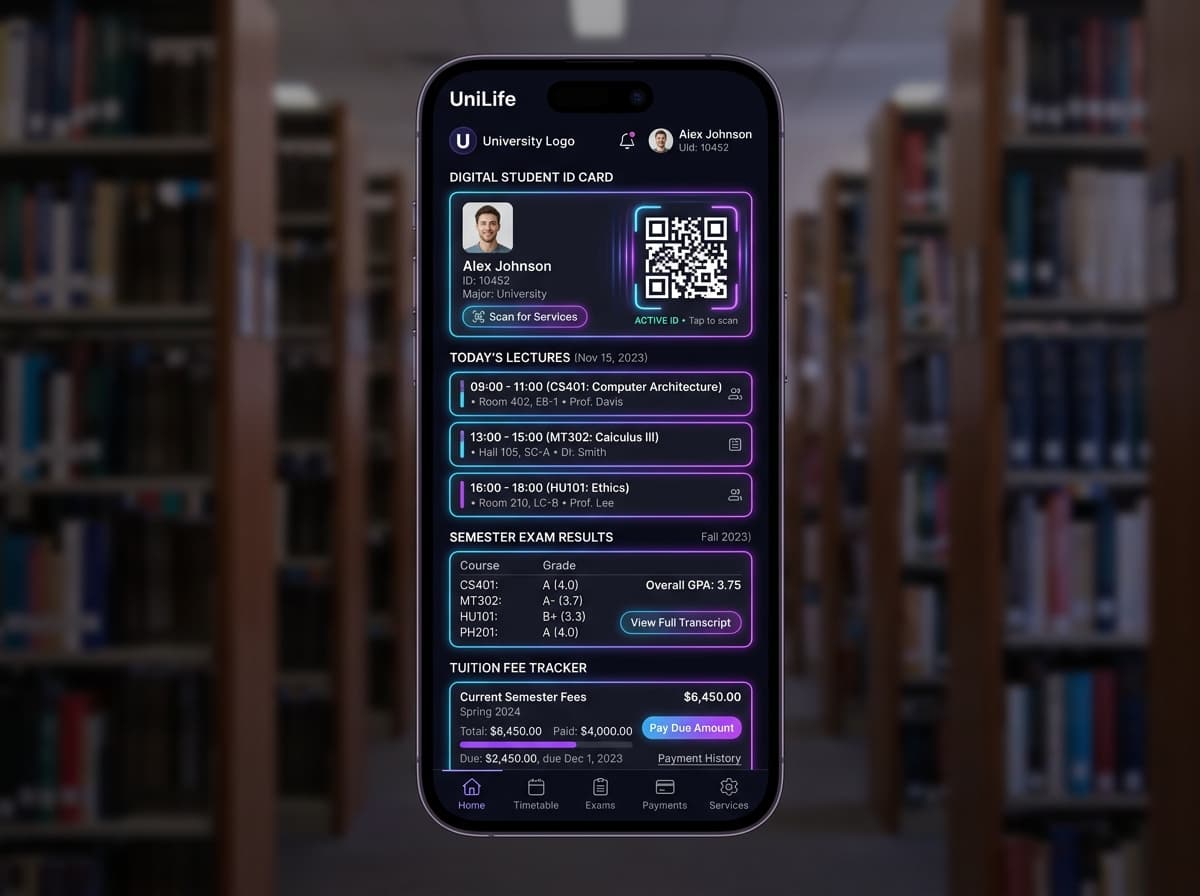
Student campus dashboard, dynamic rotating QR attendance badge, and real-time exam schedule module.
Campus Super-App & Assessment Queue Topology
Unified Campus Super-App & Digital Identity
Rather than forcing students to juggle five separate portals for timetable, mess hall balances, library checkouts, and fee payments, our super-app unifies the entire university lifecycle into a single native mobile interface with biometric login.
Real Security & Concurrency Implementation
Here are two production-verified code snippets: the client-side HMAC dynamic QR token generator that prevents proxy attendance sharing, and the Go Redis stream worker that absorbs 10,000 concurrent exam submissions without dropping tests.
// Client-Side Time-Based HMAC Dynamic QR Generator
// Regenerates every 3 seconds to prevent WhatsApp screenshot proxy attendance
import CryptoJS from 'crypto-js';

export function generateDynamicAttendanceToken(
  studentUuid: string,
  deviceHardwareId: string,
  secretHmacSeed: string
): string {
  // 3-second time slice window
  const timeStep = Math.floor(Date.now() / 3000);

  // Hash combines student identity, unique device hardware ID, and time window
  const payload = `${studentUuid}:${deviceHardwareId}:${timeStep}`;
  const signature = CryptoJS.HmacSHA256(payload, secretHmacSeed).toString(CryptoJS.enc.Hex);

  // Returns compact 16-character encoded QR payload
  return `UNI:${studentUuid.slice(0, 8)}:${timeStep}:${signature.slice(0, 16)}`;
}
Operational Comparison: Legacy Web Portals vs. Ldvia Super-App
Concrete metrics observed when replacing fragmented campus websites with a unified native mobile application and stream-buffered backend.
| Campus Function | Fragmented Legacy Web | Ldvia Campus Super-App | University Outcome |
|---|---|---|---|
| Classroom Attendance | Takes 12 minutes of roll call | Completed in 45 seconds via dynamic QR | Reclaims 11 minutes of teaching per lecture |
| Proxy Attendance Fraud | 14% proxy rate via paper sheets | 0% proxy rate (3-sec HMAC token + device ID) | 100% accurate compliance and accreditation logs |
| Exam Concurrency Limit | Crashes at > 800 simultaneous hits | Handles 10,000+ submissions per second | Zero exam re-sits caused by portal timeouts |
| Student App Adoption | 24% active portal engagement | 96% daily active mobile engagement | Direct push notification reach for notices |
Estimate University Server Cost Savings & Concurrency
Adjust the sliders to match your enrolled student body size and peak concurrent exam volume to model server infrastructure cost savings and proxy fraud elimination.
₹32 Lakhs
Eliminates over-provisioned enterprise server instances via lightweight Go Redis streaming.
100% Clean
Dynamic 3-second TOTP tokens prevent WhatsApp screenshot proxies.
Stream-Buffered Architecture vs. Legacy Web Portals
Why modern higher education institutions replace fragmented PHP/Java web portals with asynchronous stream queues and mobile super-apps.
| University Process | Legacy Fragmented Portals | Ldvia Campus Super-App | Academic Consequence |
|---|---|---|---|
| Classroom Attendance Speed | Takes 12 minutes of manual roll call | Completed in 45 seconds via dynamic QR | Reclaims 11 minutes of teaching per lecture |
| Proxy Attendance Fraud | 14% proxy rate via paper sheets | 0% proxy rate (3-sec HMAC token + device ID) | 100% accurate compliance and accreditation logs |
| Exam Concurrency Limit | Crashes at > 800 simultaneous hits | Handles 10,000+ submissions per second | Zero exam re-sits caused by portal timeouts |
| Student App Adoption | 24% active portal engagement | 96% daily active mobile engagement | Direct push notification reach for notices |
Three Non-Obvious Edge Cases Solved in Production
Campus environments feature thousands of tech-savvy students actively trying to bypass digital rules. Here are three critical engineering hurdles we encountered and solved.
1. Screen Recording / Video Forwarding
The Hazard: Students screen-recorded their dynamic QR codes or live-streamed their screens over Discord to allow remote friends to scan in.
The Resolution: We enforced strict OS-level FLAG_SECURE window protection preventing screen captures and embedded an invisible rotating steganographic watermark verified by scanner sensors.
2. 10,000 Clock Sync Discrepancies
The Hazard: Students manually changed system clocks on cheap Android devices to roll back expired exam submission windows or attendance tokens.
The Resolution: We implemented TrueTime NTP monotonic socket sync on app startup. The app calculates true delta from server clocks, ignoring local device clock tampering completely.
3. Mess Hall Offline Double-Spending
The Hazard: When campus Wi-Fi dropped during lunchtime, students used digital meal tokens across two cafeteria counters simultaneously before servers synced.
The Resolution: We deployed an ad-hoc Bluetooth Low Energy (BLE) peer-to-peer mesh between cashier POS readers. Scanners communicate token burns locally in under 30ms without internet.
Frequently Asked University Architecture Questions
Why do university examination portals crash during final semester submissions?
Standard university portals use relational SQL databases with heavy connection pools. When thousands of students click submit at exactly 11:59:59 PM, simultaneous database writes trigger connection timeouts and lock contention. We deploy an in-memory Redis stream queue that buffers 10,000+ submissions per second with sub-5ms write speeds.
How does the app prevent students from taking screenshots of attendance QR codes to help friends?
The QR code regenerates dynamically every 3 seconds using a sliding time window and is bound to the physical device hardware ID. By the time a student screenshots and forwards the image over WhatsApp, the token has already expired and will be rejected by the scanner.
Can this campus app integrate with our existing university ERP and LMS?
Yes. Our backend provides bidirectional REST endpoints and webhooks that sync attendance, timetable changes, exam grades, and fee receipts directly into SAP Student Lifecycle, Ellucian Banner, Canvas, or Moodle.
Does the student super-app support offline functionality on campus?
Yes. Course timetables, campus maps, bus schedules, and digital ID cards are cached locally in SQLite. Students can present their digital ID badge at security gates even with zero cellular data reception.
Supporting Engineering Capabilities
Modernize Your University Mobile Infrastructure
Eliminate proxy attendance and examination crashes. We engineer secure, high-concurrency campus super-apps tailored to modern university networks.