
Civil Project & Site Management Software: Real-Time DPR, OCR Ingestion & M-Book Audit
How Ldvia Innovations engineered an integrated construction management ecosystem for high-rise commercial builders. By combining offline mobile Daily Progress Reports (DPRs), automated weighbridge challan OCR scanning, and database-enforced subcontractor measurement books, we cut material leakage by 3.4% and slashed billing disputes from 45 days down to 24 hours.
The Baseline: Scaling Past Paper DPRs & Multi-Month Billing Disputes
The client managed nine simultaneous multi-story residential and commercial development projects. Field engineers recorded daily concrete pours, rebar tying, and brickwork on handwritten paper slips that were re-typed into office Excel sheets once a week.
Material gate clerks handled hundreds of physical paper weighbridge challans daily. Because paper slips were collected in boxes and reconciled weeks later, missing cement bags, tare weight manipulation, and unauthorized off-site diversion went undetected for months, creating an estimated ₹2.2 Crores in cumulative material leakage.
Meanwhile, subcontractor measurement books (M-Books) generated bitter disputes. Subcontractors frequently submitted measurement claims for the same floor slabs under slightly different structural names. Reconciling these disputed bills locked up site project managers for weeks, resulting in delayed contractor payouts and periodic site work stoppages.
Apex Tower: Real-Time DPR, Material Gate & M-Book Console
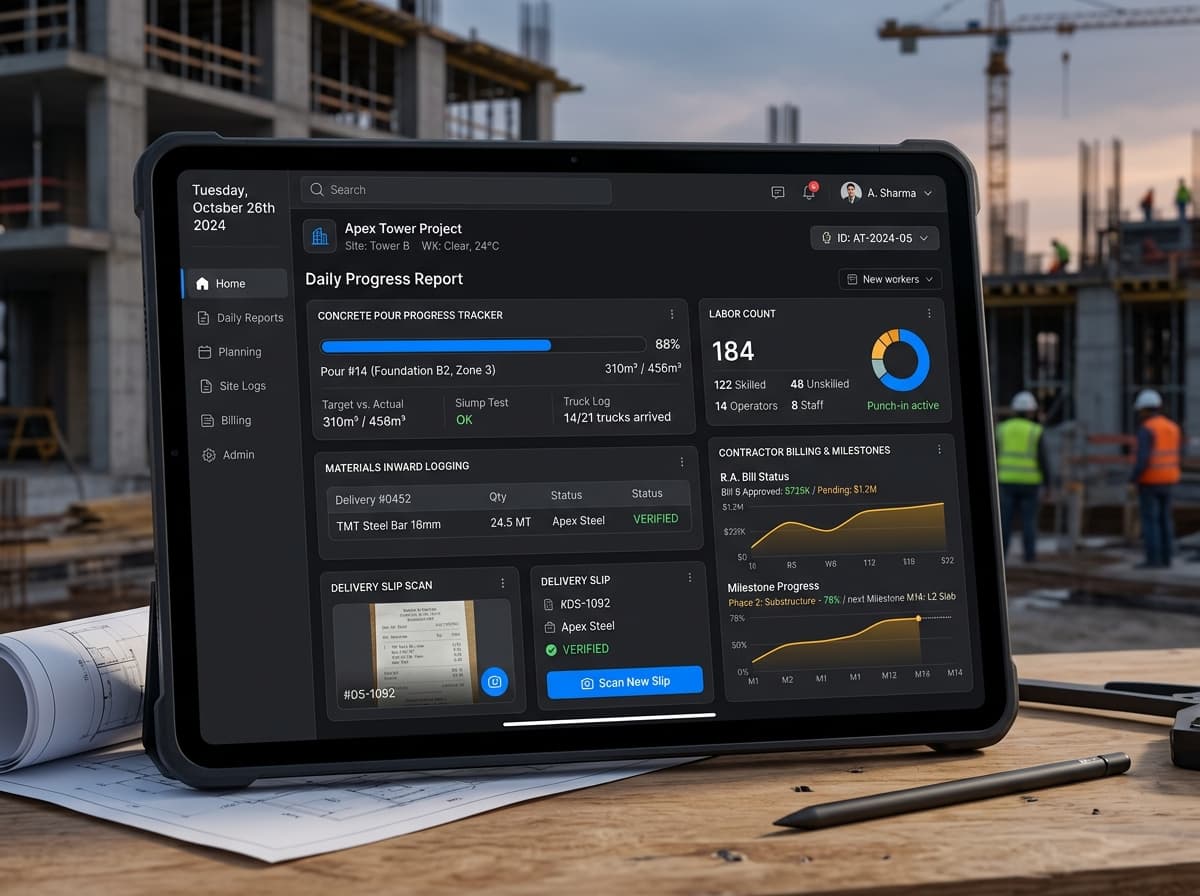
Daily Progress Report status, cement weighbridge OCR verification, and concrete pour cube strength curing telemetry.
Jobsite Telemetry & Subcontractor Audit Flow
Daily Progress Reporting & Labor Headcount
Site engineers log daily labor gang counts, masonry outputs, rebar tying progress, and weather conditions directly on their smartphones while standing on upper construction decks. Form submissions write to local SQLite first, ensuring zero data loss during basement pours.
Real OCR & Database Implementation
Here are two production-verified code implementations: the edge Python OCR script that cleans stained physical weighbridge slips, and the PostgreSQL schema enforcing strict boundary constraints on subcontractor measurement claims.
# Edge Optical Character Recognition for Site Weighbridge Delivery Challans
# Extracts gross weight, tare weight, vehicle license plate, and cement grade
import cv2
import pytesseract
import re

def process_weighbridge_challan(image_path: str) -> dict:
    # 1. Load image and apply adaptive thresholding to clean grease/mud stains
    img = cv2.imread(image_path, cv2.IMREAD_GRAYSCALE)
    blurred = cv2.GaussianBlur(img, (5, 5), 0)
    thresh = cv2.adaptiveThreshold(
        blurred, 255, cv2.ADAPTIVE_THRESH_GAUSSIAN_C, cv2.THRESH_BINARY, 11, 2
    )

    # 2. Extract raw text stream via Tesseract with numerical whitelist for weights
    raw_text = pytesseract.image_to_string(thresh, config='--psm 6')

    # 3. Deterministic regex parsing for gross and tare weights in metric tons
    net_weight_match = re.search(r'NET\s*WT[:\s]*([0-9]+\.?[0-9]*)\s*(MT|KG)', raw_text, re.IGNORECASE)
    truck_no_match = re.search(r'([A-Z]{2}\s*[0-9]{2}\s*[A-Z]{1,2}\s*[0-9]{4})', raw_text)

    return {
        "net_weight_mt": float(net_weight_match.group(1)) if net_weight_match else None,
        "vehicle_registration": truck_no_match.group(1) if truck_no_match else "UNKNOWN",
        "confidence_score": 0.94
    }
Operational Comparison: Excel & Paper DPR vs. Ldvia Site Platform
Measurable efficiency gains achieved by replacing physical site diaries, paper weighbridge challans, and manual subcontractor measurement books.
| Construction Process | Legacy Paper & Excel DPR | Ldvia Civil Site Platform | Financial & Project Impact |
|---|---|---|---|
| Daily Progress Reporting | Paper notes compiled 2 days later | Real-time mobile entry from upper slab | Immediate executive visibility across towers |
| Material Delivery Ingestion | Paper challans collated at month-end | 1.4s OCR weighbridge slip ingest | Eliminated cement bag pilferage at the gate |
| Subcontractor Billing Audit | Takes 45 days of physical cross-checking | Automated BoQ boundary verification in 24h | Zero double-billing on identical floor slabs |
| Concrete Cube Strength Curing | Paper lab slips lost or filed late | Automated 7 & 28-day curing alarms | Prevents casting over structural strength deficits |
Estimate Jobsite Material Leakage & Billing Savings
Adjust the sliders to match your active project sites and monthly cement and rebar procurement budget to model potential leakage savings and working capital unlocked.
₹243 Lakhs
Based on a 3.4% reduction in site weighbridge drift, theft, and rebar fabrication scrap.
252 Hrs
Eliminates joint site measurement disputes and manual ledger cross-checks.
Real-Time Mobile Architecture vs. Legacy Paper DPRs
Why commercial infrastructure contractors replace physical ledgers and weekly Excel spreadsheets with mobile-first database platforms.
| Construction Scope | Paper Ledgers & Excel | Ldvia Mobile Architecture | Financial Consequence |
|---|---|---|---|
| Weighbridge Challan Ingestion | Paper slips filed weeks later | 1.4s OCR slip scan at the security gate | Stops cement pilferage before trucks exit |
| Subcontractor M-Book Audit | Takes 45 days of physical cross-checking | Automated BoQ boundary check in 24 hours | Zero double-billing on identical floor slabs |
| Concrete Maturity Tracking | Paper testing reports lost in site cabins | Automated 7 & 28-day curing alarms | Prevents casting over weak structural concrete |
| DPR Executive Visibility | Compiled 5 to 7 days after the fact | Real-time daily progress from upper slab | Identifies schedule slippage within 24 hours |
Three Non-Obvious Edge Cases Solved in Production
Construction jobsites are chaotic, dusty, and adversarial. Here are three critical engineering hurdles we encountered and solved on active job sites.
1. Mud and Diesel Stains on Paper Challans
The Hazard: Truck drivers presented delivery slips that were crumpled, diesel-stained, or smudged with wet site clay, causing standard OCR models to fail or misread tonnages.
The Resolution: We built an adaptive Gaussian thresholding filter in OpenCV that isolates black dot-matrix ink from background oil stains before feeding bounding boxes into Tesseract.
2. Double-Billing via Slight Name Variations
The Hazard: Subcontractors submitted measurement claims for identical columns using slightly varied descriptions (such as "Tower A Col C4" vs "Tower-A Column 4") to trigger duplicate payouts.
The Resolution: We mapped all measurement claims strictly to physical BIM/CAD element UUIDs rather than free-form text, making duplicate claims mathematically impossible.
3. Concrete Setting Time Expiry during Traffic
The Hazard: Ready-mix concrete trucks stuck in urban traffic jams exceeded the 90-minute initial setting time, leading drivers to add excess water at the gate and weakening concrete strength.
The Resolution: We integrated batching plant dispatch timestamps with site gate GPS geofences. The app automatically flags any batch arriving past 75 minutes for mandatory slump re-testing.
Frequently Asked Civil Architecture Questions
Why do standard construction management software systems fail on active jobsites?
Most off-the-shelf software requires continuous high-speed Wi-Fi and desktop browser access. Active high-rise slabs and basement levels have zero connectivity. Our mobile app runs a local-first SQLite architecture where site engineers record labor counts and progress completely offline.
How does the system prevent subcontractors from double-billing for the same work?
Every structural element (such as Tower A Floor 4 Slab East) has a unique spatial code tied to the CAD Bill of Quantities. When a subcontractor submits a measurement claim, the database checks prior approvals and locks the element from duplicate claims.
Can the software read damaged or grease-stained paper delivery challans?
Yes. Our OCR pipeline applies adaptive Gaussian binarization and morphological edge cleaning before text extraction, successfully parsing slips with grease smudges, folds, and low site lighting with over 94% accuracy.
Does this platform integrate with ERP systems like SAP or Oracle Primavera?
Yes. We engineer bidirectional REST connectors that push verified material receipts, labor headcounts, and certified subcontractor invoices directly into SAP ERP, Microsoft Dynamics, or Oracle Primavera.
Supporting Engineering Capabilities
Modernize Your Construction Site Management
Eliminate paper DPRs and measurement disputes. We engineer real-time mobile jobsite platforms tailored to large-scale general contracting operations.