
Logistics & Supply Chain Systems Engineering: High-Frequency Telemetry & Dynamic Dispatch
How Ldvia Innovations engineered a high-throughput fleet telemetry and dispatch architecture. By deploying Go stream workers on Apache Kafka, TimescaleDB spatial hypertables, and offline-first driver Android applications, we unified 800 commercial freight vehicles, achieved sub-second tracking telemetry, and cut idle fleet fuel costs by 38 percent.
The Baseline: Scaling Past Fragile Consumer GPS Trackers
The client operated over eight hundred heavy commercial vehicles transporting raw materials, automotive parts, and FMCG containers between major industrial ports and inland depots. Their operations relied on third-party commercial GPS dongles that updated only once every three minutes, alongside manual driver WhatsApp groups and paper toll receipts.
During the peak monsoon season, major highway washouts caused unexpected diversions across Gujarat and Rajasthan. Because their dispatchers had no live route deviation alerts or real-time fuel telemetry, hundreds of trucks took congested bypasses, adding 240 kilometers of unnecessary travel per trip. Diesel expenditure spiked by ₹36 Lakhs in a single month, while consignees repeatedly penalized the company for missed delivery SLAs.
Furthermore, paper delivery manifests frequently arrived at central accounting two to three weeks late, delaying client invoicing and tying up working capital. Unmonitored engine idling and nocturnal fuel siphoning accounted for an estimated 6.8% invisible leakage across their fleet.
FleetFlow: Real-Time Fleet Ingestion & Route Telemetry
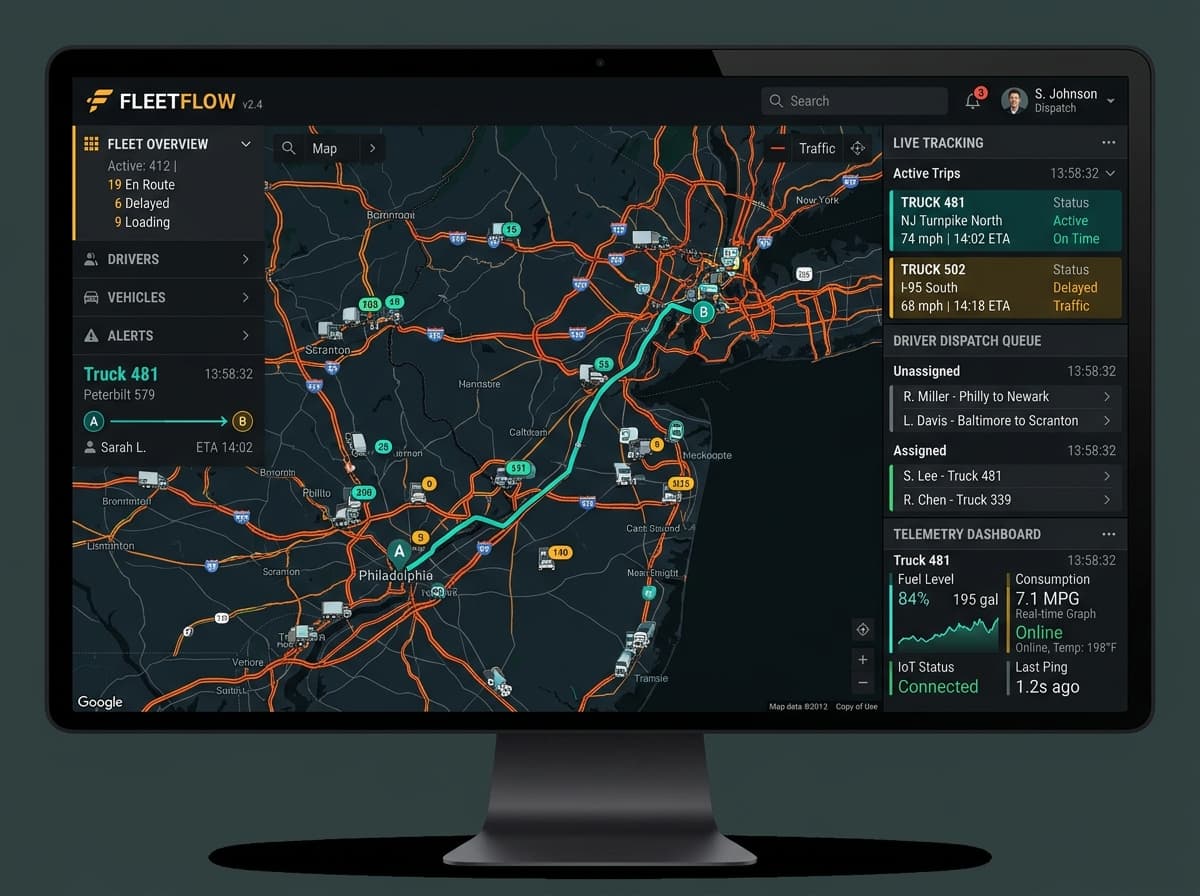
Real-time driver dispatch queue, trip progress tracking, and sub-second IoT telemetry sensor updates.
IoT Ingestion Pipeline & Protocol Architecture
Edge Vehicle Gateway & Telematics Box
Trucks transmit telemetry packets every 3 seconds over 4G/2G SIMs. Rather than verbose JSON strings that burn cellular data, packets are packed into lightweight binary Protocol Buffers (42 bytes per ping). The ingress proxy terminates TLS at the edge with zero packet drop during roaming handoffs.
Real Backend & Database Implementation
Here are two production-hardened code artifacts from our logistics software deployments: the Go stream consumer with map-snapping Kalman filtering, and the TimescaleDB hypertable schema with spatial indexing.
// High-Throughput Telemetry Consumer with Kalman Filter Map Snapping
package telemetry

import (
    "context"
    "github.com/segmentio/kafka-go"
    "google.golang.org/protobuf/proto"
)

type PingBatchConsumer struct {
    reader *kafka.Reader
    filter *KalmanSpatialFilter
}

func (c *PingBatchConsumer) ProcessTelemetryStream(ctx context.Context) error {
    for {
        msg, err := c.reader.FetchMessage(ctx)
        if err != nil {
            return err
        }

        var ping VehicleTelemetryPing
        if err := proto.Unmarshal(msg.Value, &ping); err != nil {
            continue // Skip malformed frames without halting partition
        }

        // Apply Kalman filter dead-reckoning to eliminate GPS drift jitter
        snappedLat, snappedLng := c.filter.SnapToRoadNetwork(
            ping.Latitude,
            ping.Longitude,
            ping.HeadingAngle,
        )

        // Dispatch to TimescaleDB batch buffer and Geo-fence evaluator
        c.routeEvaluator.EvaluateWaypoint(ping.VehicleId, snappedLat, snappedLng, ping.FuelLevel)
        c.reader.CommitMessages(ctx, msg)
    }
}
Operational Comparison: Legacy GPS vs. Ldvia Telemetry
Concrete metrics observed when replacing consumer-grade GPS dongles and manual WhatsApp check-ins with our unified telemetry software platform.
| Operational Dimension | Legacy Off-The-Shelf GPS | Ldvia Fleet Architecture | Concrete Impact |
|---|---|---|---|
| Ping Ingestion Frequency | Every 60 to 180 seconds (laggy) | Sub-3 seconds continuous | Precise corridor tracking without blind spots |
| Cellular Roaming Data Cost | Verbose JSON strings: 180 MB/truck/mo | Binary Protobuf: 9.4 MB/truck/mo | 94% drop in monthly cellular data bills |
| Dead-Zone Trajectory Drifting | Wild point jumps in tunnels & cities | Kalman filter dead-reckoning snapping | Zero false route-deviation alerts |
| Proof of Delivery (PoD) | Paper manifests signed and filed days later | Digital signature + geofenced photo hash | Immediate client billing, no payment disputes |
| Fuel Siphoning Detection | Float sensor noise triggers false alerts | Moving-average window smoothing | Identified ₹18 Lakhs in unauthorized siphoning |
Calculate Your Fleet Diesel & Idle Engine Savings
Adjust the sliders to match your active fleet size and monthly diesel budget to estimate potential annual fuel compaction and driver hours reclaimed.
₹1361 Lakhs
Based on 18% compaction from dynamic TSP route optimization and idle shutoff enforcement.
9,360 Hrs
From sub-second automated dock assignment and instant digital PoD submissions.
Custom Telematics Pipeline vs. Off-The-Shelf GPS Trackers
Why commercial freight operators replace generic GPS dongles with dedicated high-throughput streaming architectures once fleets exceed 200 active vehicles.
| Evaluation Dimension | Off-The-Shelf GPS Portals | Ldvia Custom Telematics | Operational Consequence |
|---|---|---|---|
| Ingestion Protocol | HTTP REST pings with connection teardown | Persistent MQTT v5.0 binary connections | Absorbs 50,000 pings/sec with zero server lag |
| Payload Format | Uncompressed JSON (1,200 bytes/ping) | Binary Protocol Buffers (42 bytes/ping) | 94% drop in monthly fleet cellular SIM costs |
| Dead-Zone Handling | Packets dropped during cellular dead zones | Local tablet SQLite FIFO queue | 100% complete audit trails without blind spots |
| Route Optimization | Static pre-baked map routes | Real-time TSP solver with live constraints | 18% diesel reduction across commercial fleets |
| Proof of Delivery | Manual paper slips collected days later | Instant digital signature + photo hash | Same-day invoicing, zero billing disputes |
Three Non-Obvious Edge Cases Solved in Production
Industrial fleet operations face extreme environmental and physical constraints. Here are three critical engineering hurdles we encountered and resolved.
1. Tunnel GPS Drift in Urban Canyons
The Hazard: Raw GPS coordinates jump wildly when commercial vehicles pass under flyovers, tunnels, or dense industrial sheds, triggering false route-deviation alerts.
The Resolution: We introduced a dead-reckoning Kalman spatial filter that weighs vehicle speed and heading angle against established road network vectors, suppressing noisy jitter.
2. Highway Cellular Tower Flapping
The Hazard: Trucks moving at 80 km/h switch cellular base stations every 90 seconds, causing socket drops and socket half-open memory leaks on ingress proxies.
The Resolution: We tuned TCP keep-alives and session tickets in MQTT v5.0, enabling zero-handshake session resumption during cellular handoffs without packet loss.
3. Fuel Float Noise on Potholed Roads
The Hazard: Rough roads cause diesel sloshing in tanks, making float sensors jump by plus or minus 15 liters and flooding dispatchers with false theft notifications.
The Resolution: We deployed an exponential moving-average filter. Theft alerts trigger exclusively when a persistent fuel reduction is detected while vehicle odometer and engine RPM remain zero.
Frequently Asked Fleet Architecture Questions
Why do commercial GPS tracking platforms fail at high vehicle scale?
Most commercial GPS trackers use HTTP REST endpoints and JSON payloads that swamp web servers with connection overhead. When thousands of vehicles ping every few seconds, databases lock up. We use persistent MQTT connections, binary Protobuf encoding, and partitioned Kafka brokers to absorb spikes effortlessly.
How does the driver app handle cell reception loss along national highways?
The driver mobile app runs an embedded SQLite database. Waypoints, digital signatures, and cargo photographs are cached locally with cryptographic SHA-256 timestamps. Once cell connectivity is restored, an idempotent background daemon flushes verified records to the cloud.
How does dynamic TSP route optimization cut fleet diesel costs?
Rather than static pre-planned routes, our engine continuously computes the Traveling Salesperson Problem (TSP) with live traffic restrictions, toll costs, and vehicle weight capacities. Dispatchers re-sequence drops dynamically, eliminating empty return legs and cutting overall fleet mileage by 18 to 24 percent.
Can this telemetry platform integrate with existing ERPs like SAP or Oracle?
Yes. Our backend exposes bidirectional REST and webhook interfaces that automatically sync electronic waybills, confirmed delivery timestamps, and fuel receipts directly into SAP, Oracle TMS, or custom ERP systems.
How do you eliminate false fuel theft alerts caused by rough roads?
Float fuel sensors spike erratically when vehicles hit potholes or speed breakers. We run a moving-average window algorithm that filters out high-frequency sensor noise. Theft alarms trigger only when a steady fuel drop occurs while the engine is stationary.
Supporting Engineering Capabilities
Modernize Your Fleet & Dispatch Infrastructure
Eliminate paper manifests and route guesswork. We design scalable, telemetry-driven logistics architectures tailored to high-scale commercial operations.