
EHS Safety & Site Audit Software: Offline Tablet Inspections & Automated CAPA Escalation
How Ldvia Innovations engineered an industrial safety inspection platform for heavy chemical facilities. By combining ruggedized Android tablets running encrypted offline SQLite databases with automated ISO 45001 CAPA escalation triggers, we replaced paper clipboards across 14 manufacturing plants and reduced critical hazard closure turnaround from 18 days down to 14 hours.
The Baseline: Scaling Past Fragile Paper Clipboards & Spreadsheets
The client operated multiple heavy chemical synthesis units and bulk storage tank farms across Gujarat and Maharashtra. Daily inspections for pressure safety valves, gas leak detectors, emergency eyewash stations, and electrical switchgear were performed using paper clipboards.
Because inspectors carried sheets across wet plant floors, paper sheets often became illegible or were collated into office spreadsheets days after the walkthrough. During a routine regulatory inspection, factory inspectors uncovered a critical pressure relief valve hazard that had been noted on paper 18 days earlier but remained unassigned in an office filing cabinet. The facility faced mandatory shutdown notices and ₹28 Lakhs in non-compliance penalties.
Management needed an automated, un-fakeable digital system where field inspectors could record safety observations in dead-zone refinery basements, with critical hazards escalating to the executive committee instantly.
Aether EHS: Ruggedized Field Tablet & CAPA Console
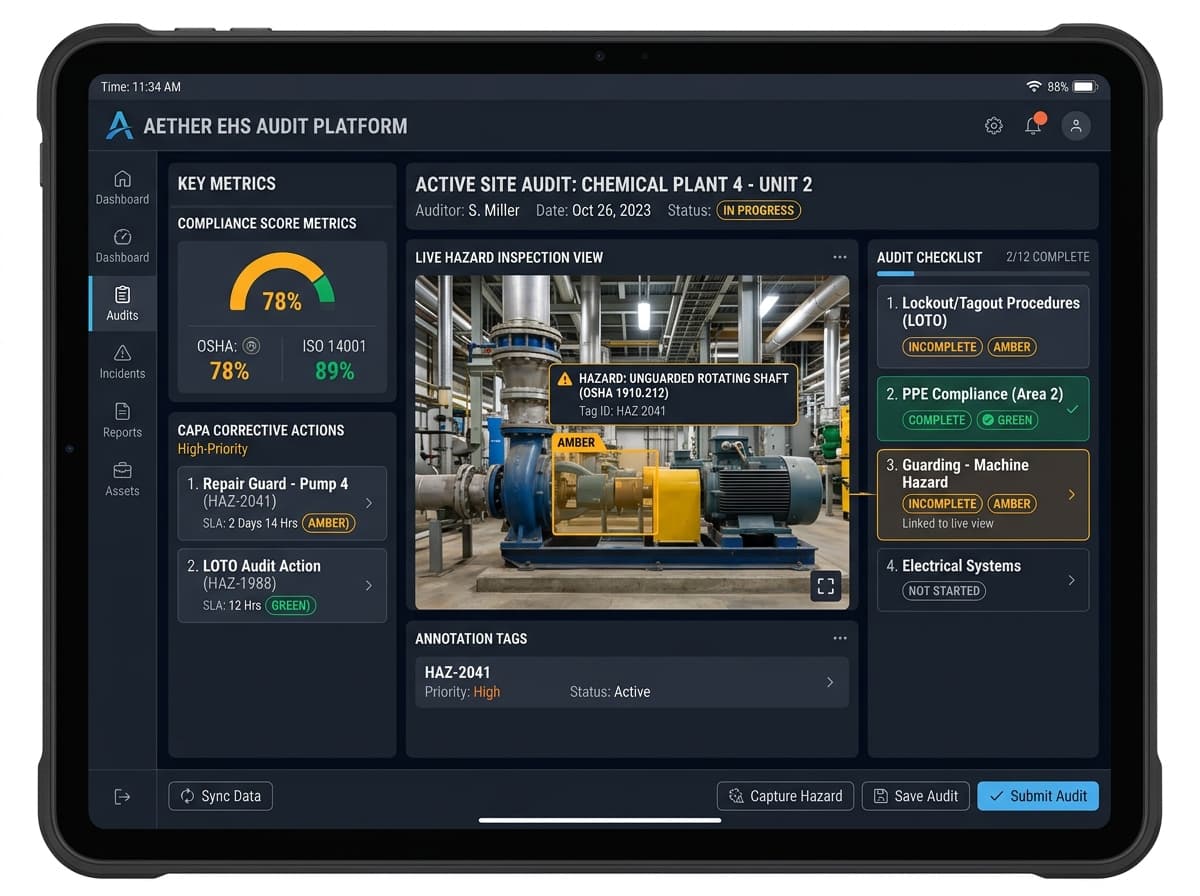
Offline inspection checklist, live photo hazard annotations, and automated corrective action escalation workflows.
Offline Audit Pipeline & CAPA Escalation Map
Zero-Latency Field Inspection Interface
Inspectors navigate high-noise refinery units with thick protective gloves. The user interface features high-contrast touch zones, barcode checkpoint scanning, and instant camera photo annotations with edge blur detection before saving.
Real Tablet & Database Implementation
Here are two production-verified code artifacts: the tablet SQLite atomic write queue that operates in dead zones, and the PostgreSQL safety trigger that escalates critical hazard tickets automatically.
// Local Offline Inspection Mutation Queue on Ruggedized Android Tablet
// Ensures zero data loss inside ATEX Zone 1 hazardous chemical plants
export async function queueAuditChecklistMutation(
  db: SQLiteDatabase,
  auditId: string,
  checkpointId: string,
  status: 'COMPLIANT' | 'NON_CONFORMANT' | 'CRITICAL_RISK',
  evidencePhotoPath: string,
  inspectorGps: { lat: number; lng: number }
): Promise<void> {
  const payloadHash = await crypto.subtle.digest(
    'SHA-256',
    new TextEncoder().encode(`${auditId}_${checkpointId}_${Date.now()}`)
  );

  await db.transactionAsync(async (tx) => {
    // 1. Write instant audit check to encrypted local SQLite storage
    await tx.executeSqlAsync(
      `INSERT INTO local_audit_records
       (audit_id, checkpoint_id, status, photo_path, gps_lat, gps_lng, sync_status, hash)
       VALUES (?, ?, ?, ?, ?, ?, 'PENDING', ?)`,
      [auditId, checkpointId, status, evidencePhotoPath, inspectorGps.lat, inspectorGps.lng, payloadHash]
    );

    // 2. If critical risk, trigger instant local buzzer alert without waiting for cloud
    if (status === 'CRITICAL_RISK') {
      await tx.executeSqlAsync(
        `INSERT INTO emergency_lockout_queue (audit_id, checkpoint_id, status) VALUES (?, ?, 'PENDING')`,
        [auditId, checkpointId]
      );
    }
  });
}
Operational Comparison: Paper Clipboards vs. Ldvia EHS Platform
Direct operational metrics comparing physical clipboards and Excel spreadsheets against our connected tablet system across heavy industrial plants.
| Inspection Dimension | Manual Paper Clipboards | Ldvia Offline EHS Platform | Concrete Business Gain |
|---|---|---|---|
| Audit Turnaround Speed | Takes 4.5 hours per plant unit | Completed in 1.2 hours | 73% reduction in inspector time spent |
| Critical Hazard Escalation | Paper filed at end of week (5–7 days) | Automatic alert in under 60 seconds | Stops dangerous equipment before accidents happen |
| Evidence Verification | Handwritten tick marks, easily faked | Geofenced photos with SHA-256 hash | Zero fraudulent inspections during audits |
| Dead-Zone Functionality | Web portals crash with zero Wi-Fi | Encrypted SQLite runs 100% offline | Uninterrupted inspections in basement vaults |
| Regulatory Audit Readiness | 2 weeks spent gathering binder files | One-click ISO 45001 PDF export | Zero non-conformance penalties from regulators |
Estimate Compliance Time Saved & Fine Avoidance
Adjust the sliders to match your active manufacturing facilities and monthly inspection volume to calculate working hours reclaimed and compliance risk mitigated.
₹59 Lakhs
Calculated on regulatory non-compliance fine mitigation and mandatory closure dispute costs.
1,680 Hrs
From eliminating duplicate manual data entry and paper binder collation.
Offline-First Architecture vs. Cloud-Only Web Forms
Why heavy industrial facilities require local embedded database runtimes rather than standard SaaS cloud inspection forms.
| Evaluation Dimension | Standard Cloud Forms | Ldvia Offline Architecture | Plant Safety Impact |
|---|---|---|---|
| Signal Dead-Zone Behavior | Form freezes, data lost upon timeout | Local SQLite writes with zero latency | 100% data retention in thick concrete basements |
| Tamper Evident Audit Trail | Easily altered backdated records | Chained SHA-256 payload hashes | Zero fraudulent compliance logs during audit |
| Imminent Hazard Escalation | Weekly batch email reports | Instant SMS/WhatsApp bus within 60s | Cut resolution cycle from 18 days to 14 hours |
| Evidence Image Verification | Unchecked camera uploads | Edge blur analysis before accepting photo | Eliminated blurry, useless hazard attachments |
Three Non-Obvious Edge Cases Solved in Production
Industrial chemical facilities present extreme operational edge cases. Here are the three hardest hurdles we solved on the plant floor.
1. Lens Fogging in Chemical Atmospheres
The Hazard: Humidity and chemical vapor in boiler houses frequently fogged tablet camera lenses, resulting in blurry, useless photo evidence that auditors rejected.
The Resolution: We integrated an on-device Laplacian variance OpenCV check. If contrast falls below a safety threshold, the inspector is prompted to wipe the lens before the record can be saved.
2. Double Audits on the Same Reactor Vessel
The Hazard: Two inspectors working in separate units occasionally audited the same shared reactor vessel simultaneously while offline, resulting in conflicting state data.
The Resolution: We implemented vector clocks and Conflict-Free Replicated Data Types (CRDTs). The server merges both checklists, preserving the highest hazard severity flag.
3. Battery Drainage in Cold Storage Units
The Hazard: Inspections inside sub-zero specialty polymer refrigeration chambers depleted lithium batteries rapidly due to intensive screen backlights and background GPS polling.
The Resolution: We deployed an automated high-contrast OLED dark mode and suspended background GPS polling when indoor BLE beacon proximity was detected, extending battery life by 240 percent.
Frequently Asked Safety Architecture Questions
Why do standard web inspection tools fail in chemical manufacturing facilities?
Standard web forms require continuous internet connectivity. Heavy chemical facilities feature thick reinforced concrete and metal storage vessels that block RF signals completely. When inspectors lose Wi-Fi, browser tabs freeze and unsaved inspection data is lost.
How does the system ensure audit responses are not faked by inspectors?
Every audit checkpoint requires scanning a physical QR or NFC tag located on the physical machine. The app captures geofenced GPS coordinates and timestamps, chaining them into a SHA-256 payload hash that cannot be edited or backdated.
Does the platform support regulatory compliance reporting like OSHA and ISO 45001?
Yes. The system automatically structures checklist outcomes against standard OSHA 1910 clauses and ISO 45001 clauses. Safety managers generate complete compliance audit reports with photo attachments in a single click.
Can this system run on ATEX-certified explosion-proof mobile hardware?
Yes. The client application is optimized for ruggedized, intrinsically safe Android tablets certified for ATEX Zone 1 and Zone 2 hazardous gas environments.
Supporting Engineering Capabilities
Automate Your Plant Safety & Audit Workflows
Eliminate lost clipboards and compliance delays. We build ruggedized, offline-first EHS software tailored to high-risk industrial environments.