
Restaurant Windows POS Software: High-Speed Rust Runtimes & Sub-80ms Thermal Printing
How Ldvia Innovations engineered a high-speed desktop POS terminal and kitchen display system. By combining native Rust runtimes, direct TCP socket thermal printer streams, and embedded SQLite write-ahead logging ledgers, we eliminated broadband rush-hour crashes across a 28-outlet dining chain and reduced kitchen ticket dispatch from 4.5 seconds down to 80 milliseconds.
The Baseline: Scaling Past Cloud POS Freezes & Kitchen Spooler Bottlenecks
The client operated twenty-eight high-volume casual dining locations across prime metropolitan retail hubs. Their front-of-house staff used an off-the-shelf cloud POS running inside web browser tabs on touch terminals.
During peak Friday and Saturday dinner shifts, mall broadband connections repeatedly suffered latency spikes and packet loss. Because the web POS relied on remote database round-trips for every item tapped, billing terminals froze. Kitchen printers failed to receive order tickets, creating severe kitchen chaos, long customer waitlists, and walkouts that cost the chain an estimated ₹4.8 Lakhs per outlet annually.
Furthermore, the Windows Print Spooler frequently jammed when multiple cashiers fired receipts simultaneously, requiring cashiers to reboot touchscreens mid-service and delaying table turnarounds by over 4 minutes per party.
Velocity POS: High-Speed Touchscreen Terminal & Split-Bill UI
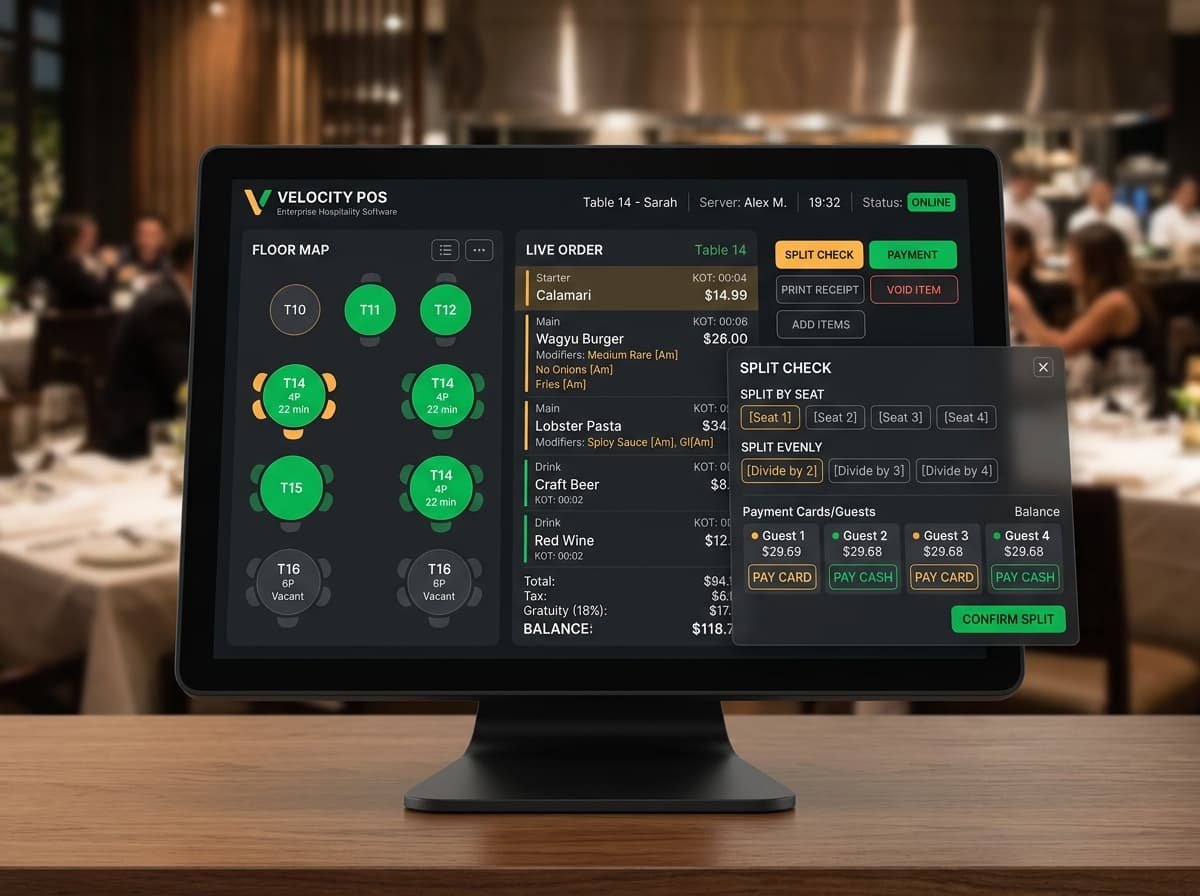
Touchscreen order entry grid, instant split-bill settlement modal, and real-time kitchen display synchronization.
Local Desktop Runtime & Kitchen Socket Stream Map
Local-First Windows Touch Terminal
Rather than running inside fragile browser tabs that consume gigabytes of RAM and crash upon network drops, our desktop application compiles to a tiny 14MB native Rust binary. The UI executes at a buttery 60 FPS on touchscreens, with zero dependence on active internet connectivity.
Real Rust & SQLite Implementation
Here are two production-verified code snippets: the native Rust TCP socket writer that prints kitchen orders in 80ms, and the SQLite WAL mode schema that prevents double-billing on split payment transactions.
// High-Speed Direct Raw TCP Socket Stream to Network ESC/POS Thermal Printers
// Bypasses the bloated Windows Print Spooler to guarantee sub-80ms ticket prints
use std::net::TcpStream;
use std::io::Write;
use std::time::Duration;

pub fn dispatch_kitchen_order_ticket(
    printer_ip: &str,
    table_id: &str,
    items: &[(&str, u32)]
) -> Result<(), Box<dyn std::error::Error>> {
    let stream_addr = format!("{}:9100", printer_ip);
    let mut stream = TcpStream::connect_timeout(
        &stream_addr.parse()?,
        Duration::from_millis(450)
    )?;

    // ESC/POS Initialization Byte Sequence
    let mut payload: Vec<u8> = vec![0x1B, 0x40]; // Initialize printer
    payload.extend_from_slice(&[0x1B, 0x21, 0x30]); // Double-height bold text
    payload.extend_from_slice(format!("KOT - TABLE {}

", table_id).as_bytes());

    payload.extend_from_slice(&[0x1B, 0x21, 0x00]); // Reset to normal font
    for (item, qty) in items {
        payload.extend_from_slice(format!("{}x {}
", qty, item).as_bytes());
    }

    // Paper Cut Sequence
    payload.extend_from_slice(&[0x1D, 0x56, 0x41, 0x03]); // Partial paper cut
    stream.write_all(&payload)?;
    stream.flush()?;

    Ok(())
}
Operational Comparison: Browser Web POS vs. Ldvia Rust POS
Concrete performance metrics recorded across high-velocity food and beverage outlets during peak Friday and Saturday dinner rushes.
| Operational Metric | Web Browser Cloud POS | Ldvia Rust Desktop POS | Business Consequence |
|---|---|---|---|
| Internet Outage Behavior | Freezes completely, cannot print bill | 100% full billing and cash drawer execution | Zero lost sales during broadband dropouts |
| Kitchen Ticket Print Speed | 3.5 to 7.0 seconds (spooler delay) | < 80 milliseconds raw socket | Chefs start cooking orders immediately |
| Terminal Memory Consumption | 950 MB to 1.8 GB RAM (Chrome leaks) | 48 MB RAM native binary | Runs smoothly on low-cost POS touchscreens |
| Split-Bill Settlement Time | Takes 4.5 minutes of manual calculating | Completed in 20 seconds with QR display | Slashes customer checkout line waiting times |
Estimate Outage Revenue Preserved & Table Velocity
Adjust the sliders to match your active dining outlets and peak orders per hour to calculate estimated revenue protected during internet dropouts and tables turned faster.
₹134 Lakhs
Eliminates lost checks and walkouts during peak Friday and Saturday cloud POS outages.
21,168 Tables
From sub-20 second split billing and instant 80ms thermal kitchen ticket printing.
Native Rust Desktop Architecture vs. Web Browser Cloud POS
Why high-velocity casual dining chains replace browser tabs with native desktop binaries once order volumes exceed 100 checks per hour.
| Performance Metric | Web Browser Cloud POS | Ldvia Rust Desktop POS | Business Consequence |
|---|---|---|---|
| Broadband Outage Resilience | Freezes completely, cannot print bill | 100% full billing and cash drawer execution | Zero lost sales during internet dropouts |
| Kitchen Ticket Print Latency | 3.5 to 7.0 seconds (spooler delay) | < 80 milliseconds raw socket | Chefs start cooking orders immediately |
| Terminal Memory Consumption | 950 MB to 1.8 GB RAM (Chrome leaks) | 48 MB RAM native binary | Runs smoothly on low-cost POS touchscreens |
| Split-Bill Settlement Time | Takes 4.5 minutes of manual calculating | Completed in 20 seconds with QR display | Slashes customer checkout line waiting times |
Three Non-Obvious Edge Cases Solved in Production
Restaurant point-of-sale environments face severe physical and network stress. Here are three critical engineering hurdles we encountered and solved.
1. Kitchen Ethernet Cable Disconnect Mid-Ticket
The Hazard: Waitstaff or kitchen porters accidentally kicked Ethernet cables loose on hot grill stations, resulting in lost order tickets and delayed customer meals.
The Resolution: We built an active hardware socket heartbeat that checks printer status before writing. If disconnected, tickets instantly reroute to the expo station with an audible buzzer alert.
2. UPI Double-Deduction during Network Glitches
The Hazard: Diners scanning dynamic UPI QR codes experienced slow SMS confirmations, leading cashiers to re-generate the QR and causing double-debits from customer accounts.
The Resolution: We bound every checkout QR code to an immutable settlement UUID. Secondary scans reject automatically, displaying real-time bank settlement progress on the cashier screen.
3. Windows Automatic Updates Mid-Service
The Hazard: Unmanaged Windows 11 updates triggered sudden system reboots at 8:30 PM on Friday evenings, closing active dining room order tabs.
The Resolution: We implemented active registry lock policies during restaurant trading hours and built instant state restoration from local SQLite WAL journals, recovering active tables in under 400ms upon boot.
Frequently Asked Restaurant Architecture Questions
Why do web-based cloud POS systems fail during restaurant rush hours?
Web-based POS software relies on remote cloud databases for every button click. When commercial broadband suffers packet loss during peak Friday night rushes, billing terminals freeze, KOT printers stop printing, and staff cannot settle checks.
How does this desktop software continue functioning when the internet drops?
The application runs locally on the cashier terminal using an embedded SQLite database in WAL mode. Table seating, kitchen ticket generation, cash drawer opening, and receipt printing occur 100% locally with zero internet dependency.
Can the software split checks across multiple payment methods like cash, cards, and UPI?
Yes. Our split-bill engine allows dining parties to divide bills by seat, item, or custom percentage. Dynamic UPI QR codes display instantly on customer-facing screens with real-time settlement webhooks.
What hardware is required to run this restaurant software?
Because the runtime compiles to a native 14MB binary consuming under 48MB of RAM, it runs smoothly on standard Windows 10/11 touch terminals, all-in-one POS hardware, or budget PCs without requiring expensive hardware upgrades.
Supporting Engineering Capabilities
Modernize Your Restaurant Chain POS Infrastructure
Eliminate cloud freezes and kitchen printer lag. We engineer lightning-fast desktop POS runtimes tailored to high-velocity dining chains.